
Reclaiming the Nations

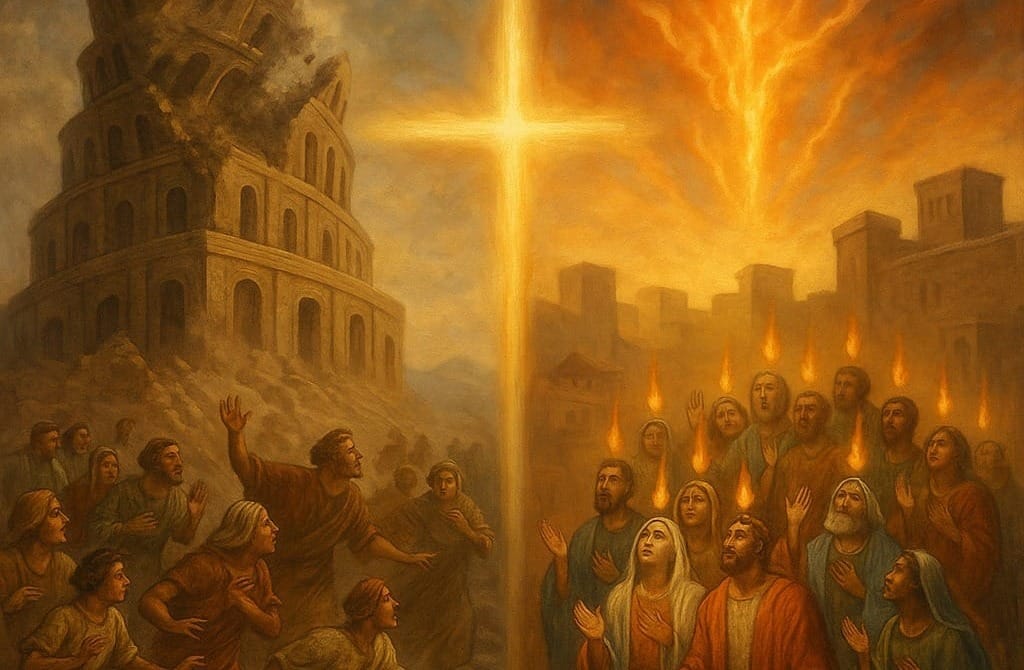
Pentecost and the Reversal of Babel: Reclaiming the Nations for Yahweh
The biblical narrative does not unfold randomly—it is a carefully structured drama of rebellion, judgment, and redemption. One of the clearest examples of this pattern occurs between two seemingly distant events: the judgment at the Tower of Babel in Genesis 11 and the outpouring of the Holy Spirit at Pentecost in Acts 2. While Babel marked the disinheritance and scattering of the nations due to collective rebellion, Pentecost served as a supernatural reversal of that judgment and the formal beginning of Yahweh's mission to reclaim the nations under the rule of His Son, Jesus the Messiah.
BABEL: HUMANITY’S UNITED REBELLION AND YAHWEH’S JUDGMENT
In Genesis 11, mankind, still united by one language and culture, gathered in defiance of God’s command to spread out and fill the earth (Genesis 9:1). Instead, they sought to build a tower—a ziggurat—that would "reach to the heavens" and make a name for themselves. This act was more than urban planning or architectural ambition; it was a spiritual rebellion. In the Ancient Near East, ziggurats symbolized sacred space, portals between heaven and earth, where humans could manipulate the gods. The Tower of Babel, therefore, represented a counterfeit mountain of assembly—an attempt to storm heaven and force divine presence on human terms.
God responded not by destroying them physically but by confusing their language. This act severed their ability to conspire as one. More significantly, according to Deuteronomy 32:8–9 (LXX and Dead Sea Scrolls versions), God responded by disinheriting the nations:
"When the Most High gave to the nations their inheritance, when he divided mankind, he fixed the borders of the peoples according to the number of the sons of God. But the Lord’s portion is his people, Jacob his allotted heritage."
This passage reveals a profound truth: Yahweh handed over the rebellious nations to lesser divine beings—members of the heavenly host often referred to as the bene elohim [sons of God]. These beings were expected to rule justly, but Psalm 82 shows that they instead oppressed and corrupted the nations under their charge, leading Yahweh to declare their doom. From Babel onward, Yahweh would focus on a single nation—Israel—through whom He would eventually bless all the nations (Genesis 12:3).
PENTECOST: THE GATHERING BEGINS
Fast forward to Acts 2. The Jewish feast of Shavuot (Pentecost) had brought devout Jews and proselytes from across the known world to Jerusalem. This was the perfect stage for the next act in Yahweh’s redemptive plan. As the disciples gathered, the Holy Spirit descended like a mighty rushing wind, and tongues of fire appeared over them. They began speaking in other languages—real, known languages of the dispersed Jewish and Gentile populations present.
This was not a coincidence. Luke, the author of Acts, intentionally records the nations represented: Parthians, Medes, Elamites, residents of Mesopotamia, Judea, Cappadocia, Pontus, Asia, and many more (Acts 2:9–11). These regions directly correspond to the Table of Nations in Genesis 10—a traditional list of the seventy (or seventy-two) nations descended from Noah. The message is clear: the judgment of Babel is being reversed. Instead of humanity ascending to God in pride and being scattered, God descends to humanity in humility and begins the process of regathering.
THE SUPERNATURAL AND COSMIC RECLAMATION
Pentecost was not just about communication—it was about cosmic authority. Jesus had told His disciples in Matthew 28:18–19, "All authority in heaven and on earth has been given to me. Therefore, go and make disciples of all nations." This was a direct claim that the authority once exercised by the gods over the nations (delegated in Deuteronomy 32:8) had been stripped from them. Jesus, through His death, resurrection, and ascension, had reclaimed what they had corrupted. Ephesians 1:20–22 echoes this, stating that Christ was raised and seated “far above all rule and authority and power and dominion,” referring not to human rulers but to spiritual ones.
At Pentecost, empowered by the Spirit, the apostles proclaimed Jesus as Lord, and 3,000 were added to their number. Many of these were likely pilgrims who would return to their nations, bringing with them the seeds of the gospel. This was the beginning of the reclamation—not just of individuals, but of entire people groups that had long been under the sway of rebellious elohim.
LUKE’S LITERARY DESIGN AND THE SYMBOLISM OF THE NATIONS
Luke, writing Acts, carefully constructs the narrative to reflect this theological truth. When Jesus sends out seventy (some manuscripts say seventy-two) disciples in Luke 10, the number is symbolic. In Jewish tradition, seventy nations were believed to represent the totality of humanity after Babel. The commissioning of the seventy is a symbolic prophetic act—just as the gospel is for all, so is the mission.
This symbolism continues in Acts. The tongues spoken at Pentecost are a sign that Yahweh’s Spirit is now moving to undo the divine divorce enacted at Babel. He is gathering a people from every tongue, tribe, and nation to become one in Christ, just as Paul describes in Ephesians 2:14:
“For he himself is our peace, who has made the two groups one and has destroyed the barrier, the dividing wall of hostility.”
THE DIVINE COUNCIL AND THE WAR FOR THE NATIONS
To fully appreciate Pentecost’s significance, we must understand it within the Divine Council worldview. Yahweh was not just reclaiming people—He was invading the territory of rival gods. Every conversion was a blow to the authority of the principalities and powers who had ruled those nations since Babel. Paul affirms this in Colossians 2:15, declaring that Christ “disarmed the rulers and authorities and put them to open shame, by triumphing over them.”
In this context, Pentecost was a declaration of war. Not a war of swords, but of Spirit. The kingdom of God was breaking into enemy territory, and the principalities of the air would fight back. But the victory was already assured. The presence of the Holy Spirit was not only a comforter—it was a sign of the age to come, the beginning of the regathering of Yahweh’s lost inheritance.
CONCLUSION:
Pentecost was not an isolated event; it was the reversal of a cosmic fracture. At Babel, the nations were scattered and handed over to lesser gods in response to their rebellion. At Pentecost, through the power of the risen Messiah, Yahweh began calling those nations back—not through domination, but through the Spirit and the proclamation of the gospel.
The Church is the instrument through which this mission continues. Every time the gospel is proclaimed, every language it is translated into, and every heart it reaches, is another piece of Babel being undone. The nations that were once disinherited are now being invited back into the family of the Most High.
This is not merely history. It is our task. The reversal of Babel began at Pentecost—and it will be completed at the return of Christ, when every knee shall bow, and every tongue confess that Jesus Christ is Lord.
_______
© 2026 Jan Ross
All Rights Reserved
“Sit often under the influence of God’s Word.”🌻
www.janross.org/devotions/

Enjoy today’s devotion?
Forward to a friend and let them know where they can subscribe (hint: it’s here).
Want to share what God is doing in your life? Submit a short story to include in a future devotion.
Anything else? Send me an email at influenced@janross.org!
👉 Want to create your own blog or website? Or know someone who's thinking about it? Use my referral link to get started! (Note: I earn a small commission at no additional cost to you if you use the referral link. Thank you for your support!)
No spam, no sharing to third party. Only you and me.


Member discussion